Article A5 · Book 1 · Scrapbook page p.5
Small problems mean a lot to these people

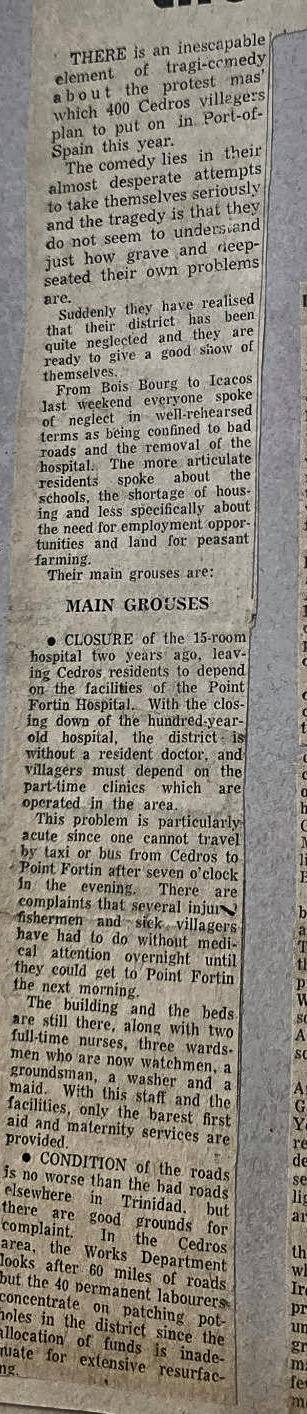
THERE is an inescapable element of tragi-comedy about the protest mas' which 400 Cedros villagers plan to put on in Port-of-Spain this year.
The comedy lies in their almost desperate attempts to take themselves seriously and the tragedy is that they do not seem to understand just how grave and deep-seated their own problems are.
Suddenly they have realised that their district has been quite neglected and they are ready to give a good show of themselves.
From Bois Bourg to Icacos last weekend everyone spoke of neglect in well-rehearsed terms as being confined to bad roads and the removal of the hospital. The more articulate residents spoke about the schools, the shortage of housing and less specifically about the need for employment opportunities and land for peasant farming.
Their main grouses are:
MAIN GROUSES
● CLOSURE of the 15-room hospital two years ago, leaving Cedros residents to depend on the facilities of the Point Fortin Hospital. With the closing down of the hundred-year-old hospital, the district is without a resident doctor, and villagers must depend on the part-time clinics which are operated in the area.
This problem is particularly acute since one cannot travel by taxi or bus from Cedros to Point Fortin after seven o'clock in the evening. There are complaints that several injured fishermen and sick villagers have had to do without medical attention overnight until they could get to Point Fortin the next morning.
The building and the beds are still there, along with two full-time nurses, three wardsmen who are now watchmen, a groundsman, a washer and a maid. With this staff and the facilities, only the barest first aid and maternity services are provided.
● CONDITION of the roads is no worse than the bad roads elsewhere in Trinidad, but there are good grounds for complaint. In the Cedros area, the Works Department looks after 60 miles of roads but the 40 permanent labourers concentrate on patching potholes in the district since the allocation of funds is inadequate for extensive resurfacing.
[Piece 3 of 4 — second column]
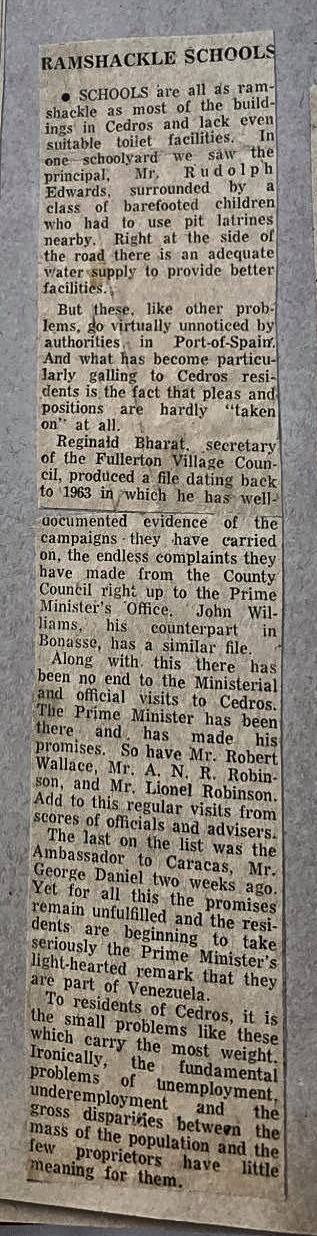
RAMSHACKLE SCHOOLS
● SCHOOLS are all as ramshackle as most of the buildings in Cedros and lack even suitable toilet facilities. In one schoolyard we saw the principal, Mr. Rudolph Edwards, surrounded by a class of barefooted children who had to use pit latrines nearby. Right at the side of the road there is an adequate water supply to provide better facilities.
But these, like other problems, go virtually unnoticed by authorities in Port-of-Spain. And what has become particularly galling to Cedros residents is the fact that pleas and positions are hardly "taken on" at all.
Reginald Bharat, secretary of the Fullerton Village Council, produced a file dating back to 1963 in which he has well-documented evidence of the campaigns they have carried on, the endless complaints they have made from the County Council right up to the Prime Minister's Office. John Williams, his counterpart in Bonasse, has a similar file.
Along with this there has been no end to the Ministerial and official visits to Cedros. The Prime Minister has been there and has made his promises. So have Mr. Robert Wallace, Mr. A. N. R. Robinson, and Mr. Lionel Robinson. Add to this regular visits from scores of officials and advisers. The last on the list was the Ambassador to Caracas, Mr. George Daniel two weeks ago. Yet for all this the promises remain unfulfilled and the residents are beginning to take seriously the Prime Minister's light-hearted remark that they are part of Venezuela.
To residents of Cedros, it is the small problems like these which carry the most weight. Ironically, the fundamental problems of unemployment, underemployment and the gross disparities between the mass of the population and the few proprietors have little meaning for them.
[Piece 4 of 4 — third column]
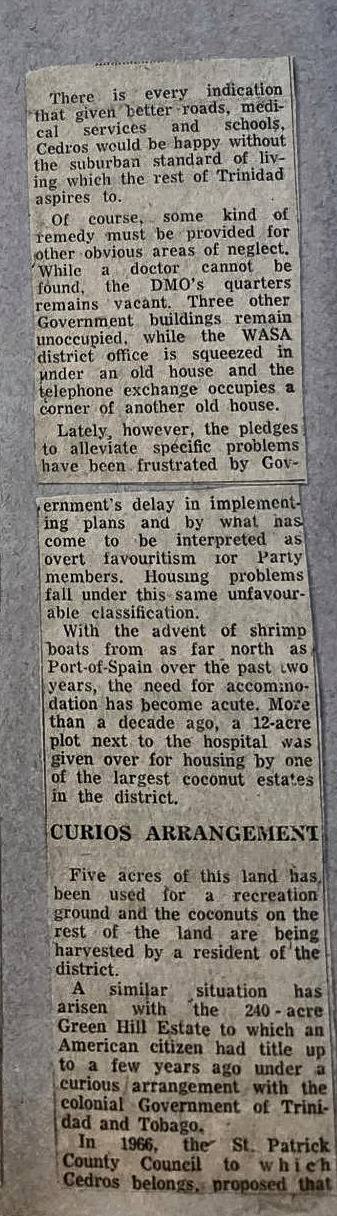
There is every indication that given better roads, medical services and schools, Cedros would be happy without the suburban standard of living which the rest of Trinidad aspires to.
Of course, some kind of remedy must be provided for other obvious areas of neglect. While a doctor cannot be found, the DMO's quarters remains vacant. Three other Government buildings remain unoccupied, while the WASA district office is squeezed in under an old house and the telephone exchange occupies a corner of another old house.
Lately, however, the pledges to alleviate specific problems have been frustrated by Government's delay in implementing plans and by what has come to be interpreted as overt favouritism for Party members. Housing problems fall under this same unfavourable classification.
With the advent of shrimp boats from as far north as Port-of-Spain over the past two years, the need for accommodation has become acute. More than a decade ago, a 12-acre plot next to the hospital was given over for housing by one of the largest coconut estates in the district.
CURIOS ARRANGEMENT
(subhead as printed; evidently "Curious Arrangement")
Five acres of this land has been used for a recreation ground and the coconuts on the rest of the land are being harvested by a resident of the district.
A similar situation has arisen with the 240-acre Green Hill Estate to which an American citizen had title up to a few years ago under a curious arrangement with the colonial Government of Trinidad and Tobago.
In 1966, the St. Patrick County Council to which Cedros belongs, proposed that
[The article continues beyond the text preserved in the scrapbook; the clipping ends here.]