Article A4 · Book 1 · Scrapbook page pp.3-4
Cedros — where even hope seems to be dying
Page 10 TRINIDAD GUARDIAN, Tuesday, January 27, 1970
Today the Guardian starts the first in a series of articles concentrating on the problems facing Cedros, by Staff Writer NIZAM ALI. The series continues tomorrow with articles dealing with the specific complaints of the residents of Cedros, the problems of the fishing industry and the prospects for improving conditions in the area.
THERE are persons who speak of Cedros with pride—the pride of having possessions, that is; and there are many people in that same area for whom Cedros evokes vague feelings of frustration and defeat — mainly self defeat. Between these two moods one can understand a great deal about that far-away and forgotten peninsula which has chosen to portray its predicament to Trinidad through a unique and most unexpected kind of protest in Port-of-Spain on Carnival Monday.
Cedros is like nowhere in the country that Northerners know about. In fact, the first thing that the Northerner learns is that there is no single town or village in the Deep South called Cedros — there are villages like Fullerton, Icacos and Bonasse. With casual indifference the rest of Trinidad has applied the name Cedros to the main village Bonasse and the label has stuck.
With the same kind of casual unconcern the rest of Trinidad generally defines the Cedros peninsula as a district of coconut estates and a few fishermen. The fact is that Cedros is the largest copra-producing area in the country and more than 50 per cent of the country's fishing industry is centred around its shores.
Feudal legacy
It boasts of a past in which exquisitely-dressed French-born ladies and sons of the landed gentry drove around the countryside in horse-drawn carriages, when the Governor of the colony would come down to witness horse racing on the beach, when the indentured "coolies" worked on the large estates and the free Negroes built crude boats and lived off the sea.
With the turn of the century the glamour has disappeared without erasing the salient elements of this essentially feudal legacy. The estates are there and fishing has expanded beyond anyone's expectations but the pride of the possessors is as much in evidence as the despair of these who are inclined to think of themselves as being dispossessed.
The vast majority of Cedros residents are trapped in the surviving relics of a 20th century feudalism which keeps them economically and psychologically committed to the owners of lands and boats. The landowners are absentee landlords in the richest 18th century tradition and the fishing financiers provide boats and gear on an eternal pay-later plan in return for exclusive rights to purchase and market all that is caught at prices they themselves determine.
They possess all the wealth and power in the area and take considerable pride in both the place and in their possessions. The others — the indebted ones—mix traces of despair with almost unshakeable loyalty to those who provide "bread." An ingrained tradition of dependence has virtually emasculated any interest in independence or in asserting oneself among the older residents and many of their children. They speak in almost endearing terms of paternal overlords like Major Taylor and the late Willie Ramjohn.
With a population of 15,000 there are about 15 wealthy families living in Cedros; the big landowners, usually absentee, can be easily counted on the fingers of both hands. With the exception of about 250 small businessmen, boat owners and Government employees, all the rest depend on two dozen persons for a living.
That living comes either from a few days' work on the estates or a chance to work on the sea. All economic activity in the area is centred around fishing and agriculture. While the latter as a business brings in more money, the earnings of the fishermen are generally better. Ironically, however, agriculture workers who are paid fortnightly, are slightly better. Ironically, however, villagers who put out to sea and collect wages every day. (repeated phrase as printed)
Sharp decline
Just under a thousand persons work on the seven large estates in Cedros, which take up nearly 8,000 acres of the peninsula. Less than half this number of residents have small holdings, barely large enough to support a house, a small kitchen garden and a cow or two.
This kind of self-sufficiency is just as unattractive as the "regular" employment on the estates. Recent years have seen a sharp decline in the availability of work on the estates, although trade unionism has introduced an element of stability. Previously twice as many persons were taken on, if and when there was "work."
Today the cost of labour has gone up, the size of the "task" has been reduced and labourers are guaranteed eight days' work per fortnight. Yet the pay remains around an unattractive $4 a day, which is about $2.50 below the minimum rate for labourers on Government projects.
Like other agricultural areas there are young men here who have made the invidious comparison and are unwilling to "take on" hard work at the going price. Only, not many people around here can assert this degree of independence.
If this could develop, the estates would be relieved, since increasing use of weedicides is making for economy and less dependence on cutlass men for cutting the grass.
Cedros has a large population of unskilled or semi-skilled workers whose predominantly functional literacy hardly makes them adaptable to new techniques or skilled work. Their methods of fishing are as old as St. Peter's and efforts at agriculture outside the plantations are steeped in time-worn tradition.
The schools taught them some reading and arithmetic—enough to read the Psalms in Church on Sundays and add up the "shop list" on weekends. Among the older folk there are still some who didn't get this far and have remained unlettered. With the others they have continued the vicious circle of existence in Cedros as virtual slaves of a benevolent but uncompromising system.
A handful broke out through college exhibitions, well-to-do parents or a combination of both. Once out they have gone on to enrich the national community with their special talents and skills. There is no place in Cedros now for men like Rupert Dolsingh, Leo Ramchand or senior politicians
[Piece 2 of 4 — scrapbook page 4, left column]
like Nicholas Simonette and George Chambers.
While there is no firm commitment to the Cedros cause among these there are occasional expressions of more than sentimental allegiance. The Minister and the Senator go down for occasional weekends, Leo Ramchand was there on Sunday to present an All Fours trophy and "Babsie" Dolsingh is hoping to help the Cedros fishermen.
One can hardly argue, therefore, that the Cedros problems of unemployment and underemployment are unknown among the really high people in the country. Along with such well-placed sons of the soil, their Parliamentary representative is Deputy Speaker Roy Richardson.
General neglect
The politics of the late fifties and sixties have their scars in Cedros as everywhere else. It is not immediately obvious, but the racial polarisation of DLP-PNM loyalties have existed and constituted a barrier to cohesive community effort. Only now have complaints crystallised into a rallying-cry for the DLP, and the PNM and the generally disinterested as well.
Former DLP Councillor Manmohansingh speaks in the same scathing terms as PNM party member Aaron Badai about the neglect of roads, schools and health services. Probably for the first time in 13 years people here are placing the interests of Cedros
[Piece 3 of 4 — scrapbook page 4, columns below the photograph]
before individual and party loyalties.
At its annual general meeting yesterday (Monday) the Bonasse Village Council expressed its "satisfaction" for the assistance it received from Mr. Richardson last year. With all the clamour that the residents are making, Mr. Richardson himself must feel more than a trifle embarrassed at this expression of confidence.
In Cedros there is a great deal more than the average apathy in community organisations. The women's groups have come up and almost died away, and there are three or four struggling PTA's which have been disenchanted by the futility of their struggles to get even proper lavatories for the schools.
Outside these organisations there are several All Fours teams 14 football teams and just as many cricket teams, but cricket suffers because the price of gear is too high and the goalposts are without nets, since the teams cannot afford to buy them.
Diversions are few so the birth rate is high and per capita consumption of alcohol must be close to the highest in the country. In a 200-yard stretch in the middle of Bonasse there are eight rumshops and snackettes all evidently well-patronised by scores of people like the famous Alexander Thorpe of rum advertising fame.
Church's bid
In all this the Church is making an almost desperate attempt to prove its relevance. At the imposing Roman Catholic Church on the hill the congregation at Mass on Sundays hardly exceeds ten. So Father Pascall is trying to interest the youths by organising a combo, and helping the steelbandsmen and mas players. The Presbyterian Church at Boisburgh, one mile away, fares slightly better.
Like the dying organisations in the district, religion has become symbolic of the decline of Cedros, the disenchantment of its residents and of
[Piece 4 of 4 — scrapbook page 4, photograph and the column fragments beside/below it]
the fact that everyone everywhere seems to be snatching at straws in the hope that things can be improved. But religion preaches hope and determination, which everyone of the 15,000 residents may have if they are to overcome their problems now and gain at some time in the future the lost Paradise that was once Cedros.
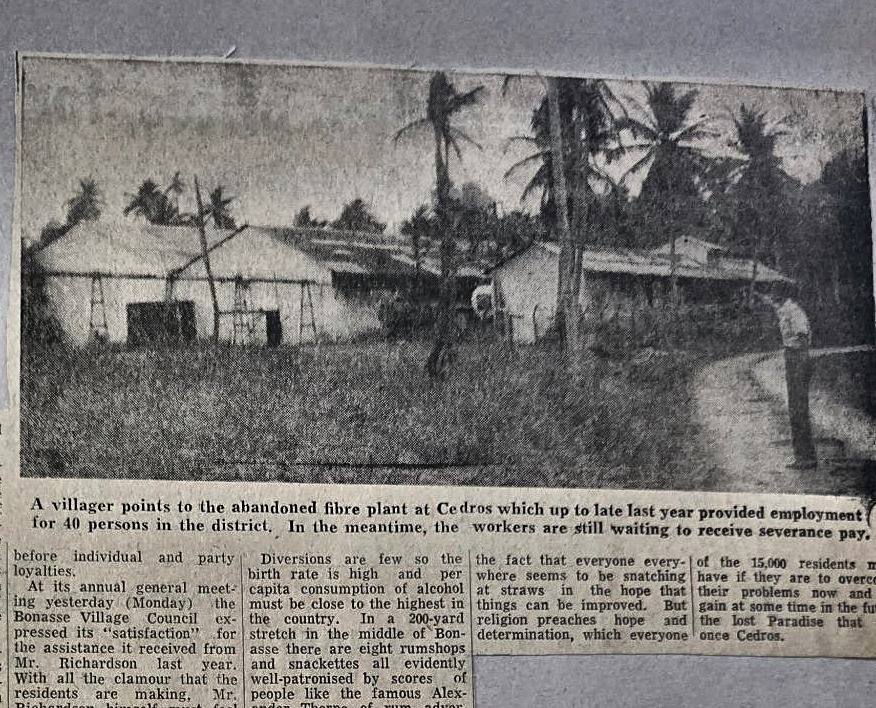
[Photograph, scrapbook page 4: buildings and palm trees at the abandoned fibre plant. Caption:]
A villager points to the abandoned fibre plant at Cedros which up to late last year provided employment for 40 persons in the district. In the meantime, the workers are still waiting to receive severance pay.