Article A9 · Book 1 · Scrapbook page p.9
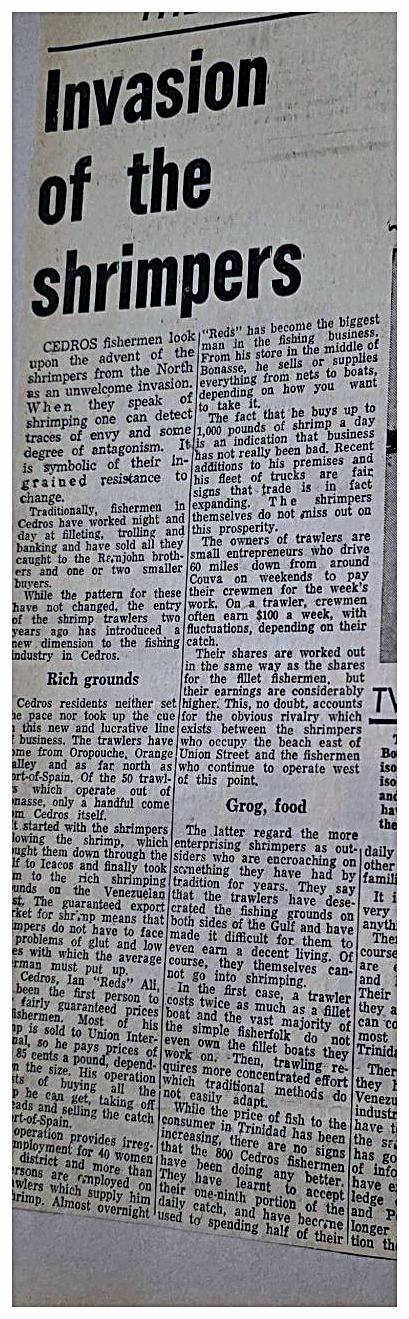
THE NEGLECTED CEDROS — Invasion of the shrimpers

Page 6 TRINIDAD GUARDIAN, Thursday, January 29, 1970
[Intro box, top right of the page:]
FISHING in Cedros has traditionally been linked with "trading" across the Gulf. In today's articles, Staff Writer NIZAM ALI writes about what has been happening "down the Main" and looks at the conflict which has arisen between the traditional fishermen and the newly-arrived shrimpers, outlining the peculiar problems that each of these faces.
CEDROS fishermen look upon the advent of the shrimpers from the North as an unwelcome invasion. When they speak of shrimping one can detect traces of envy and some degree of antagonism. It is symbolic of their ingrained resistance to change.
Traditionally, fishermen in Cedros have worked night and day at filleting, trolling and banking and have sold all they caught to the Ramjohn brothers and one or two smaller buyers.
While the pattern for these have not changed, the entry of the shrimp trawlers two years ago has introduced a new dimension to the fishing industry in Cedros.
Rich grounds
Cedros residents neither set the pace nor took up the cue in this new and lucrative line of business. The trawlers have come from Oropouche, Orange Valley and as far north as Port-of-Spain. Of the 50 trawlers which operate out of Bonasse, only a handful come from Cedros itself.
It started with the shrimpers following the shrimp, which brought them down through the Gulf to Icacos and finally took them to the rich shrimping grounds on the Venezuelan coast. The guaranteed export market for shrimp means that shrimpers do not have to face the problems of glut and low prices with which the average fisherman must put up.
At Cedros, Ian "Reds" Ali, has been the first person to offer fairly guaranteed prices to fishermen. Most of his shrimp is sold to Union International, so he pays prices of up to 85 cents a pound depending on the size. His operation consists of buying all the shrimp he can get, taking off the heads and selling the catch in Port-of-Spain.
His operation provides irregular employment for 40 women of the district and more than 300 persons are employed on the trawlers which supply him with shrimp. Almost overnight
"Reds" has become the biggest man in the fishing business. From his store in the middle of Bonasse, he sells or supplies everything from nets to boats, depending on how you want to take it.
The fact that he buys up to 1,000 pounds of shrimp a day is an indication that business has not really been bad. Recent additions to his premises and his fleet of trucks are fair signs that trade is in fact expanding. The shrimpers themselves do not miss out on this prosperity.
The owners of trawlers are small entrepreneurs who drive 60 miles down from around Couva on weekends to pay their crewmen for the week's work. On a trawler, crewmen often earn $100 a week, with fluctuations, depending on their catch.
Their shares are worked out in the same way as the shares for the fillet fishermen, but their earnings are considerably higher. This, no doubt, accounts for the obvious rivalry which exists between the shrimpers who occupy the beach east of Union Street and the fishermen who continue to operate west of this point.
Grog, food
The latter regard the more enterprising shrimpers as outsiders who are encroaching on something they have had by tradition for years. They say that the trawlers have desecrated the fishing grounds on both sides of the Gulf and have made it difficult for them to even earn a decent living. Of course, they themselves cannot go into shrimping.
In the first case, a trawler costs twice as much as a fillet boat and the vast majority of the simple fisherfolk do not even own the fillet boats they work on. Then, trawling requires more concentrated effort which traditional methods do not easily adapt.
While the price of fish to the consumer in Trinidad has been increasing, there are no signs that the 800 Cedros fishermen have been doing any better. They have learnt to accept their one-ninth portion of the daily catch, and have become used to spending half of their
[Continuation column, on the "TWO FACES OF ISOLATION" piece]
daily earnings on grog and the other half on food for their families.
It is hardly surprising that very few of them ever save anything to invest at any time. There is more hope, of course, for the shrimpers who are economically better off and less tied to tradition. Their main problem is that they are not sure whether they can continue in the light of the most recent developments in Trinidad-Venezuela relations.
There can be no doubt that they have been shrimping in Venezuelan waters and if the industry is to survive they will have to continue to operate in the same area. The situation has gone so far that the kind of informal relations which have existed outside the knowledge of officials in Caracas and Port-of-Spain, can no longer give the kind of protection they need.
They have been trying to smoothe out difficulties on their own initiative, but clearly this initiative is inadequate to face up to present problems. In recent weeks, the slightest report from Caracas has caused all boats to be tied up on the Cedros beach.
While the shrimping business has provided the only sign of a real break with tradition in the area, a cloud of uncertainty hangs over its operations. It is a situation which cries out for immediate attention.
But the broken-down pier, deserted beach and the absence of fishing facilities makes one wonder whether the people's cries will be heard way up in the St. Clair office at all.
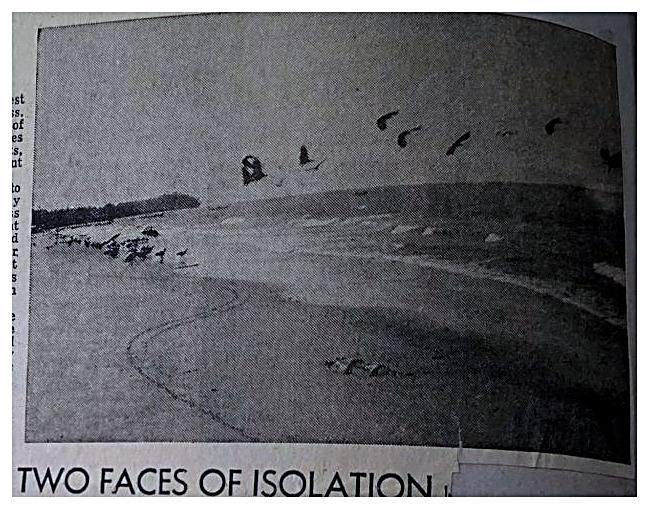
[Photograph, scrapbook page 9: the deserted beach at Bonasse, birds in flight over the shore. Caption:]
TWO FACES OF ISOLATION
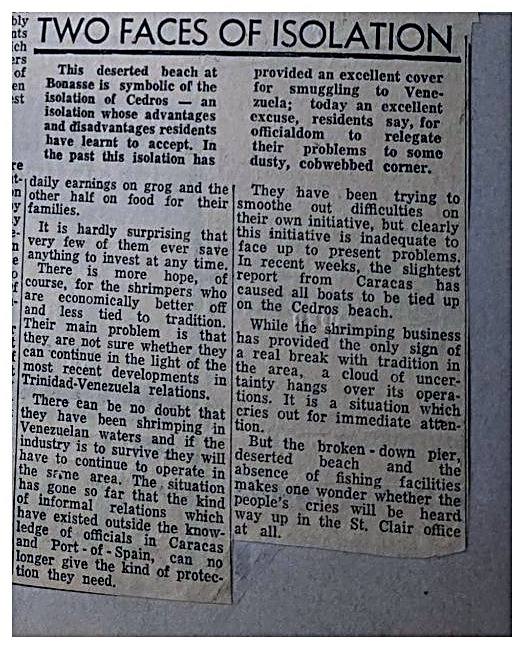
This deserted beach at Bonasse is symbolic of the isolation of Cedros — an isolation whose advantages and disadvantages residents have learnt to accept. In the past this isolation has provided an excellent cover for smuggling to Venezuela; today an excellent excuse, residents say, for officialdom to relegate their problems to some dusty, cobwebbed corner.