Article A28 · Book 1 · Scrapbook page p.25
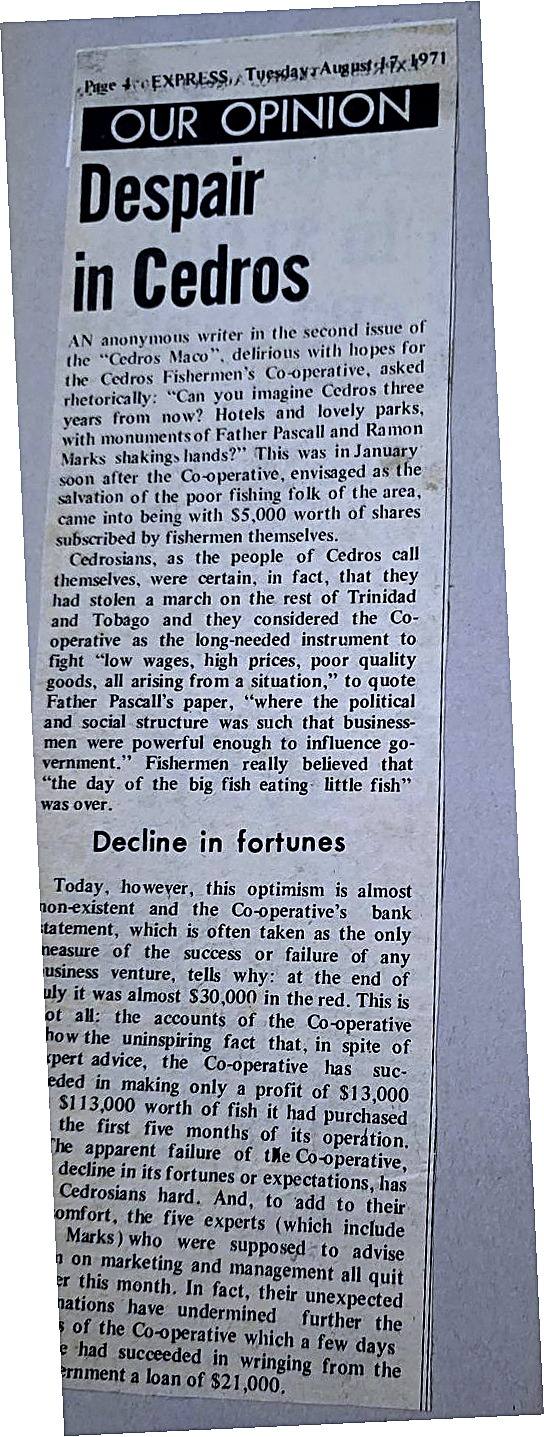
Despair in Cedros
Page 4 EXPRESS, Tuesday, August 17, 1971
AN anonymous writer in the second issue of the "Cedros Maco", delirious with hopes for the Cedros Fishermen's Co-operative, asked rhetorically: "Can you imagine Cedros three years from now? Hotels and lovely parks, with monuments of Father Pascall and Ramon Marks shaking hands?" This was in January soon after the Co-operative, envisaged as the salvation of the poor fishing folk of the area, came into being with $5,000 worth of shares subscribed by fishermen themselves.
Cedrosians, as the people of Cedros call themselves, were certain, in fact, that they had stolen a march on the rest of Trinidad and Tobago and they considered the Co-operative as the long-needed instrument to fight "low wages, high prices, poor quality goods, all arising from a situation," to quote Father Pascall's paper, "where the political and social structure was such that businessmen were powerful enough to influence government." Fishermen really believed that "the day of the big fish eating little fish" was over.
Decline in fortunes
Today, however, this optimism is almost non-existent and the Co-operative's bank statement, which is often taken as the only measure of the success or failure of any business venture, tells why: at the end of July it was almost $30,000 in the red. This is not all: the accounts of the Co-operative show the uninspiring fact that, in spite of expert advice, the Co-operative has succeeded in making only a profit of $13,000 on $113,000 worth of fish it had purchased in the first five months of its operation.
The apparent failure of the Co-operative, the decline in its fortunes or expectations, has hit Cedrosians hard. And, to add to their discomfort, the five experts (which include Mr. Marks) who were supposed to advise them on marketing and management all quit earlier this month. In fact, their unexpected resignations have undermined further the hopes of the Co-operative which a few days before had succeeded in wringing from the government a loan of $21,000.
[Continuation piece, scrapbook page 25]
A rallying point
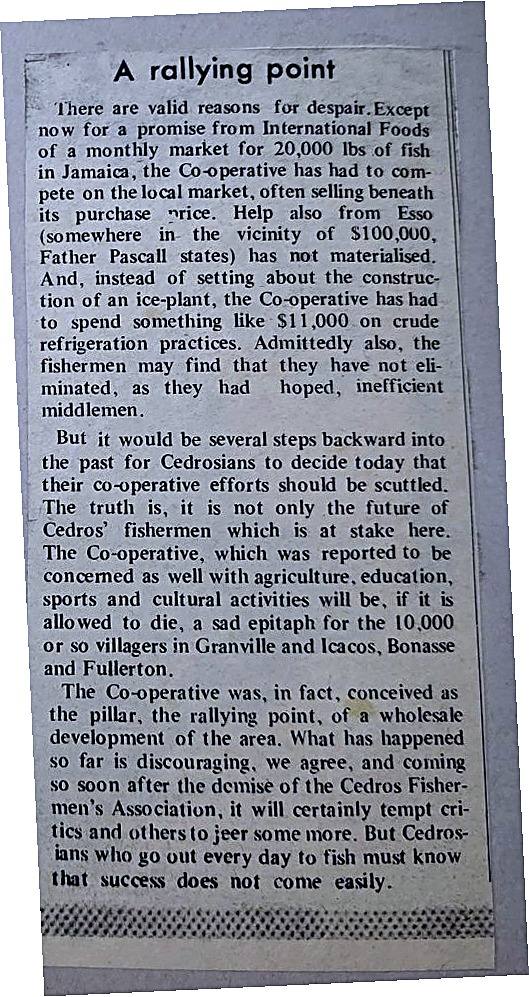
There are valid reasons for despair. Except now for a promise from International Foods of a monthly market for 20,000 lbs of fish in Jamaica, the Co-operative has had to compete on the local market, often selling beneath its purchase price. Help also from Esso (somewhere in the vicinity of $100,000, Father Pascall states) has not materialised. And, instead of setting about the construction of an ice-plant, the Co-operative has had to spend something like $11,000 on crude refrigeration practices. Admittedly also, the fishermen may find that they have not eliminated, as they had hoped, inefficient middlemen.
But it would be several steps backward into the past for Cedrosians to decide today that their co-operative efforts should be scuttled. The truth is, it is not only the future of Cedros' fishermen which is at stake here. The Co-operative, which was reported to be concerned as well with agriculture, education, sports and cultural activities will be, if it is allowed to die, a sad epitaph for the 10,000 or so villagers in Granville and Icacos, Bonasse and Fullerton.
The Co-operative was, in fact, conceived as the pillar, the rallying point, of a wholesale development of the area. What has happened so far is discouraging, we agree, and coming so soon after the demise of the Cedros Fishermen's Association, it will certainly tempt critics and others to jeer some more. But Cedrosians who go out every day to fish must know that success does not come easily.